
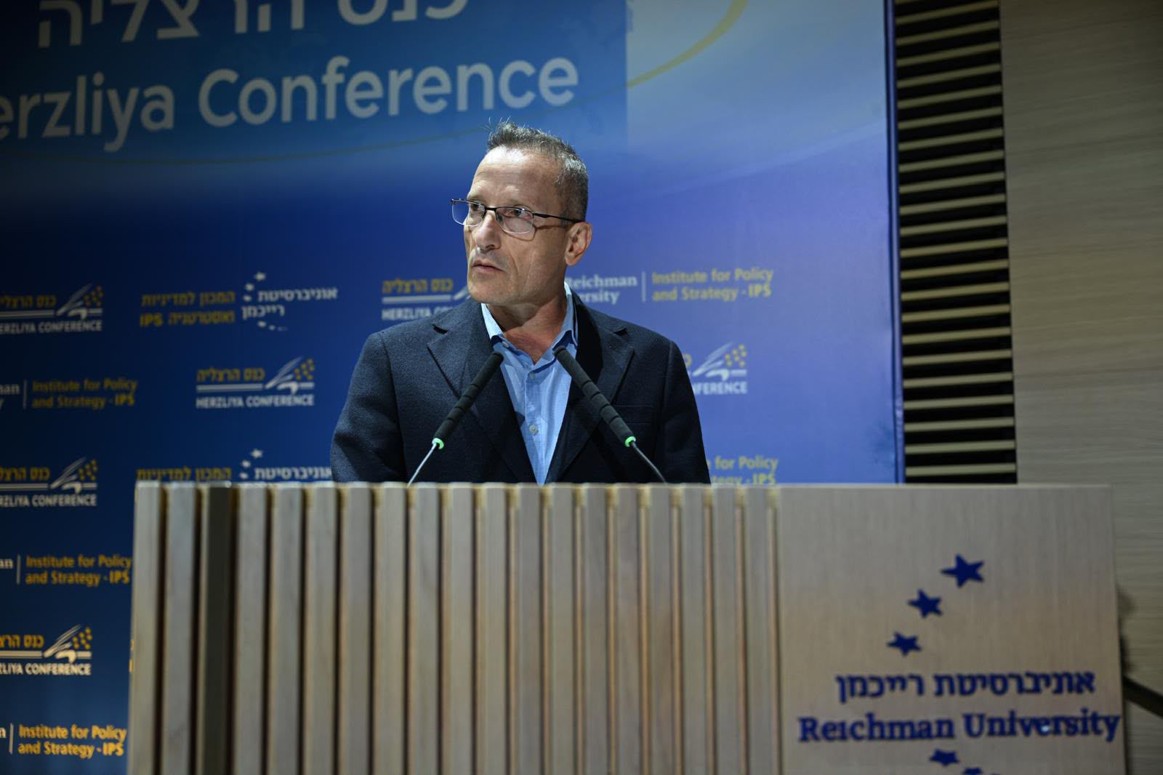
At this year’s Herzliya Conference at Reichman University in Israel, the Director General of the Israeli Ministry of Defense, Major General (ret.) Amir Baram, on July 1 argued for a targeted expansion of the armed forces, a broader alliance spanning from India to the United Arab Emirates (UAE) and extending to Greece and Cyprus, as well as for a new security memorandum of understanding (MOU) between the United States and Israel, based on concrete interests and shared values.
“The war has shown all actors in the region what price the Iranian military buildup demands. It has awakened a common interest in forging a broader alliance—from India through the UAE to Greece and Cyprus,” Baram said. He warned: “The agreements that are emerging worldwide now and could funnel hundreds of billions of dollars into Iran could drastically accelerate its military buildup.” In light of this danger, the State of Israel must bolster itself through a targeted expansion of its armed forces and push forward a new regional architecture.
Divergent Interests of Israel and the United States
With regard to the partnership with the United States and the security agreement currently being negotiated, Baram addressed domestic criticism of Washington’s approach: “We cannot afford to view the current American policy through a provincial lens. What some in Israel perceive as weakness or folly — as seemingly disregarding all warning signals on the ground — is seen in Washington as cold, calculated, and realistic risk management in a time of changing global attention.”
The difference between the two sides lies not in the assessment of the threat, but in the priorities: “For us, Iran represents an existential threat. For the United States, it is a chronic regional challenge, while China and the Indo-Pacific region are at the center of interest. From the Pentagon’s perspective — given that American munitions stockpiles are needed both to support ongoing wars and to prepare for a possible confrontation in the Taiwan Strait — a prolonged war in the Middle East runs counter to America’s global strategic orientation.”
Israeli Strengths plus the Financial Power of the Gulf States
Baram continued: “Given my deep familiarity with the divergent views within the American system, I know one thing: if there is one thing Americans hate more than this protracted war, it is the loss of a campaign already won. Since the United States already follows the ‘America First’ principle, our partnership cannot rest on shared values alone. It must also be grounded in tangible interests: a strong, independent, and proactive Israel that stabilizes the Middle East is exactly the asset that enables the United States to redirect resources toward Asia.”
“Israel’s strengths in the fields of technology, proven operational experience, and defense innovations could, in combination with the financial power of the Gulf states, open a new security- and economic-policy frontier. ‘Expanding our strategic partnerships is not a substitute for our partnership with the United States. It will, however, allow Israel to broaden its room for maneuver and its standing on the international stage, as well as diversify our strategic base,’ Baram explained.
To accelerate the production of interceptor missiles, he said: “Last year, as director general, I was compelled to exercise the full range of emergency authorities. We tackled bottlenecks directly, organized critical raw material procurement across continents, signed export contracts to expand domestic production lines, and specifically recruited workers for the involved industries. Thanks to these immediately taken emergency measures, Israel today has a stockpile that continues to grow even during ongoing fighting — but the work is not finished.”
