
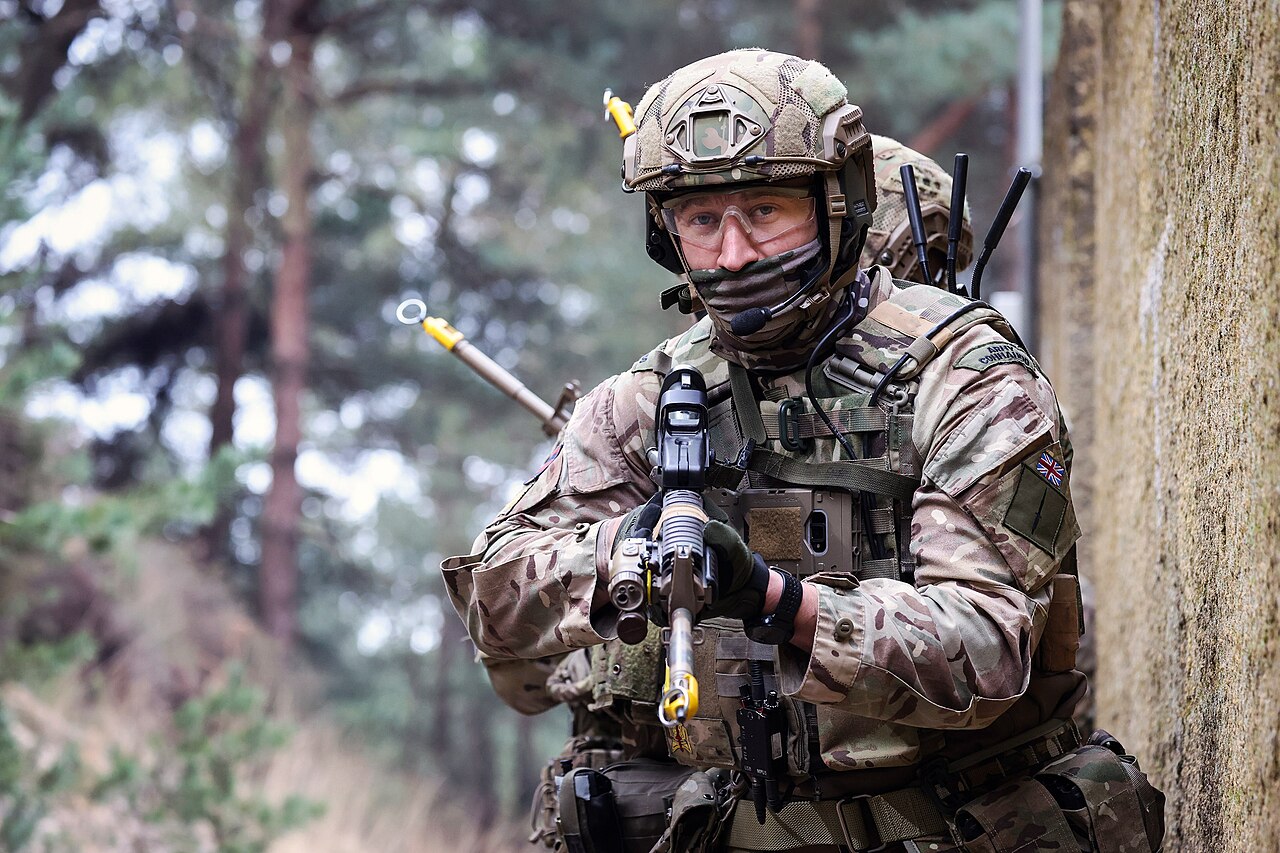
As part of its Defence Investment Plan (DIP) presented on 30 June, Britain will invest 500 million British pounds (585 million euros) over the next four years in the further development of the UK Commando Force into the Future Commando Force. Overall, the DIP foresees additional funds of 15 billion pounds (17.55 billion euros) by 2030, raising defense spending for this period to a total of 298 billion pounds (348.66 billion euros).
Alongside the Commando Force, which was officially renamed in early June by King Charles III from the former 3 Commando Brigade of the Royal Marines, among other allocations 63 billion pounds (73.71 billion euros) will be spent on modernizing nuclear deterrence, 8.6 billion pounds (10.06 billion euros) on the future air combat system GCAP, five billion pounds (5.85 billion euros) on drones and autonomous systems, and two billion pounds (2.34 billion euros) on a digital target acquisition network.

Investments in the Future Commando Force will also heavily flow into autonomous, unmanned and digital capabilities, as well as into new combat boats and amphibious ships, with 100 million pounds (117 million euros). During the ongoing transformation since 2020, the Commandos had already introduced numerous new manned and unmanned systems. The additional funds are intended mainly to strengthen deployment capabilities in the Arctic.
Project Joint Commando Craft
For the Joint Commando Craft (JCC) project pursued jointly with Norway, several designs are currently being considered for a fast, low-signature amphibious deployment craft with a displacement of up to 60 tons, capable of transporting up to 24 fully equipped Commandos and light vehicles or other loads up to six tons. A multi-day autonomous sea endurance is also required. Prototypes are to be tested from 2028.
Britain and Norway—for its littoral raiding commandos—plan to procure a total of 30 of these. On the British side, the latest emphasis has mainly been on boarding ships of the Russian shadow fleet as a mission, though this is likely to have political opportunistic grounds. New landing crafts are anyway needed, since the current LCVP Mk 5 are to be decommissioned by 2027. The successor project has so far been operated under the name Commando Insertion Craft (CIC).
History of the UK Commando Force
The history of the UK Commando Force goes back to the formation of the 3rd Special Service Brigade from the 102nd Brigade of the Royal Marines Division with additional personnel from the British Army in 1943. Since the abbreviation for “Special Service” carried unpleasant connotations to the German SS, the unit, consisting at battalion level of two Commandos from the Marines and the Army, was soon renamed Commando Brigade. During the Cold War, it consisted essentially of 40, 42 and 45 Commandos, Royal Marines, and 29 Commando Regiment, Royal Artillery of the Army.
These are also still part of the Commando Force today. In addition come 43 Commando (Fleet Protection Group), 47 Commando (Raiding Group) for naval operations, 30 Commando (Information Exploitation Group) for communications, reconnaissance and information operations, 24 Commando Regiment, Royal Engineers with Army intelligence specialists, and the Commando Logistics Regiment. The Commando Helicopter Force is also assigned, with three helicopter squadrons of the Royal Navy, which falls under the joint-service Joint Aviation Command.
