
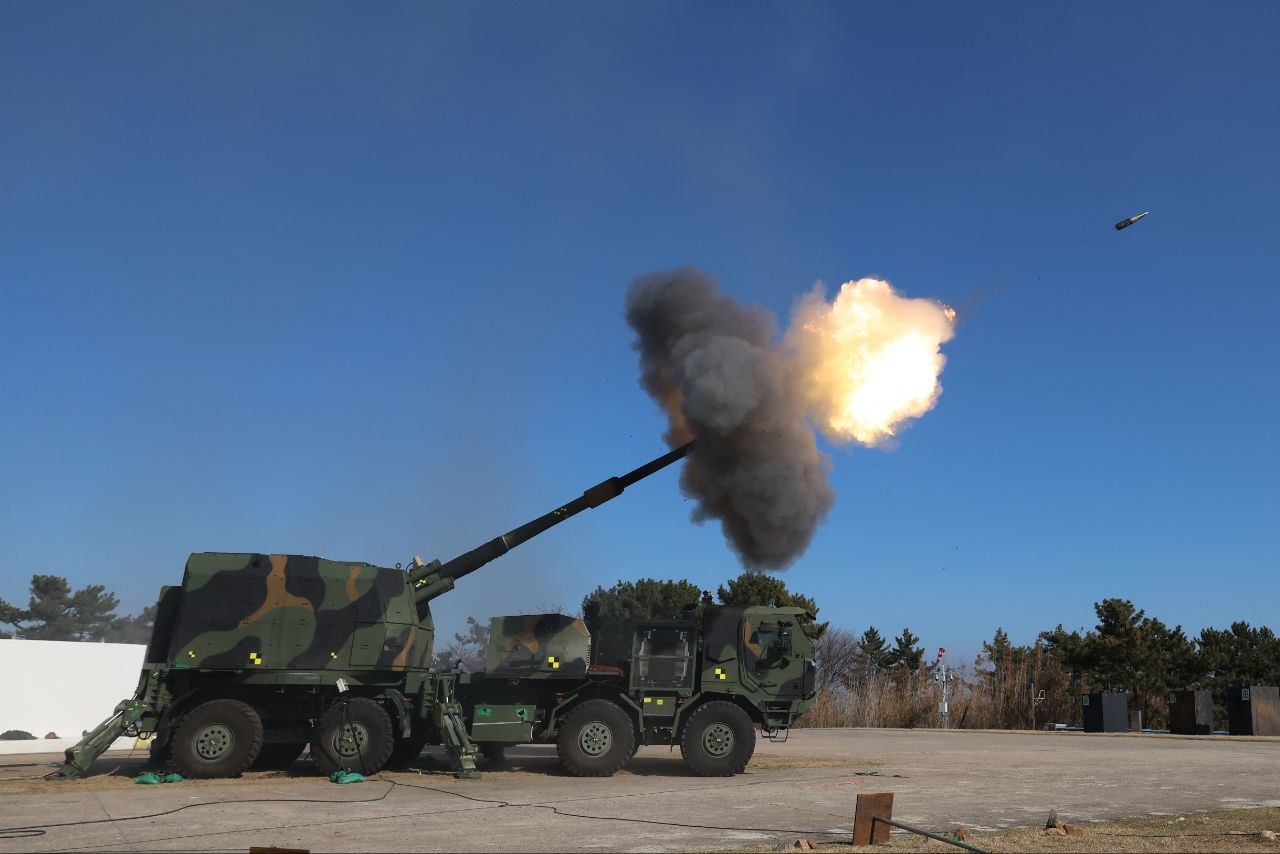
In August, the U.S. Army contracted the American subsidiary of the South Korean defense company Hanwha, as part of the Mobile Tactical Cannon (MTC) project, to deliver up to 18 prototypes of the 155-mm self-propelled howitzer K9MH. Almost two months have now passed since the first unit was delivered, as project officer Brigadier General Robert J. Mikesh Jr. stated last week ahead of the Association of the United States Army (AUSA) annual meeting and exposition in Washington, DC.
Hanwha Defense USA had announced after receiving the contract that it would establish an integration and testing facility for the system in Opelika, Alabama. The contract covers the accelerated delivery of six howitzers valued at around $100 million (€86 million) with a cumulative notional value of just under $263 million (€226 million) including the option for twelve more. As part of the MTC program to replace the towed M777 howitzer, these would undergo testing and user trials over a four-year period.
The U.S. Army will also test the Mobile Tactical Cannon on tracked chassis
Hanwha had unveiled its K9MH self-propelled howitzer on an 8×8 chassis for the first time at the 2025 AUSA show. It uses the turret of the K9A2 self-propelled howitzer with a 52-caliber-length barrel. In the A2 version, an automatic loading system is employed in conjunction with new modular propellant charges. This reduced the crew from five to three (in emergencies even two) and the firing rate rose from initially six to eight rounds per minute to nine to ten rounds per minute, or four to six rounds per minute.
In addition, the entire onboard ammunition stock of 48 rounds was relocated into the turret, which can also be equipped with an additional remotely operated weapons station. The barrel received new chrome-lined rifling to increase range and service life. Other improvements included an electric turret traverse system instead of electrohydraulic, air conditioning and a fire suppression system. This made the system suitable for remote operation on a wheeled platform. The modular propellant charge system uses insensitive munitions, further increasing crew protection.
Whether the K9MH will ultimately be fielded after testing remains to be seen. In the MTC competition, alongside Hanwha, Rheinmetall participated with the RCH 155 on a Boxer chassis, General Dynamics Land Systems with the SPH-M (Rheinmetall’s artillery gun module AGM on Piranha 10×10 also used in the RCH 155), the Israeli Elbit with the Sigma 155 and BAE Systems with Archer. At the end of August, the U.S. Army also issued a tender for a tracked version of the Mobile Tactical Cannon. Hanwha hopes to win this one as well.
