
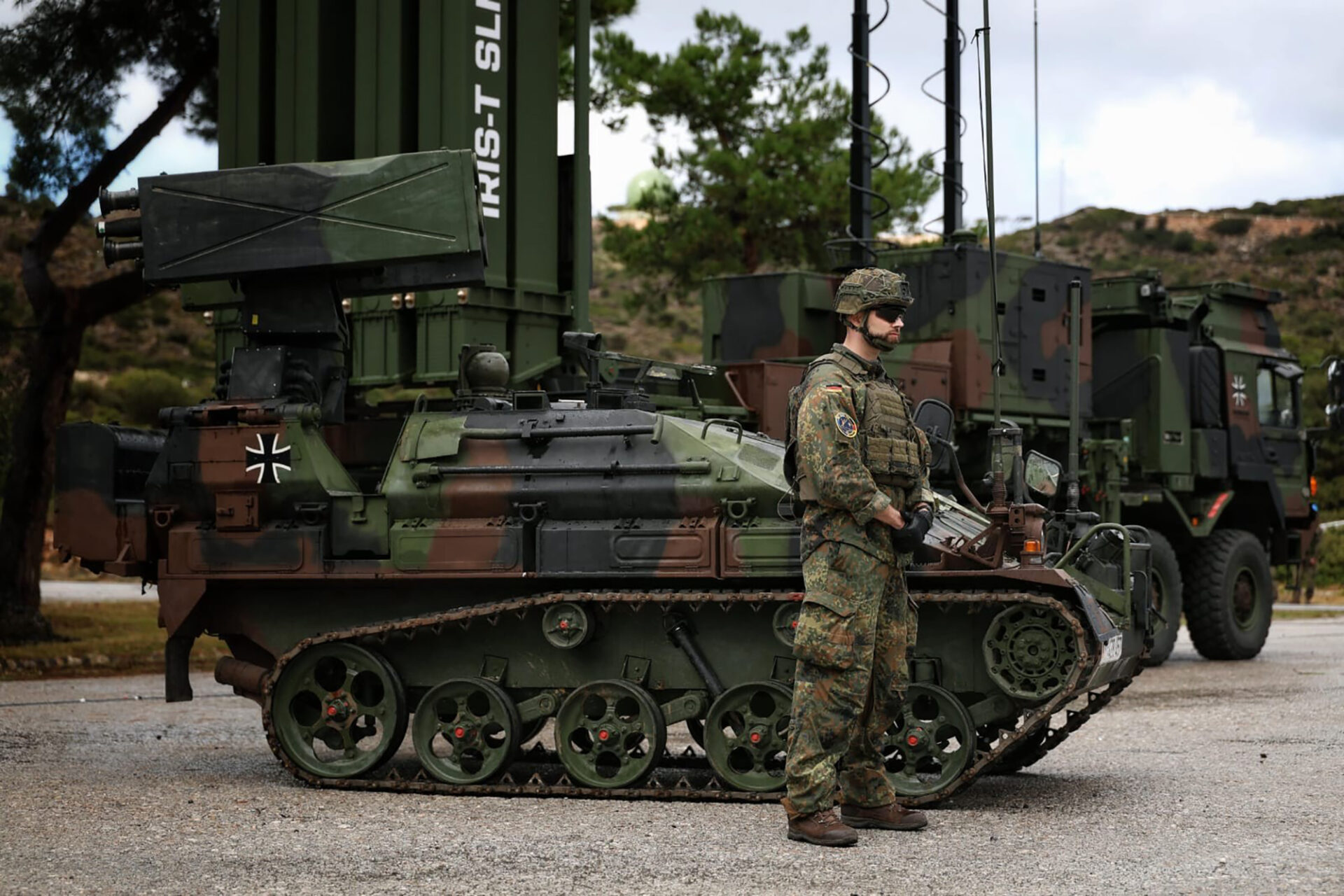
The formation of the Army’s air defense troops has taken another step. Yesterday, soldiers of the German Army took over the light air defense system (LeFlaSys) from the Air Force. Until now, the air defense system was located with the 61st Air Defense Missile Group in Todendorf; it is now moving to the newly established Army Air Defense Troops, based in Lüneburg. LeFlaSys is thus the first major weapon system of this unit, which is planned to consist of two air defense battalions in total by 2028.
The Return of the System to the Army
With LeFlaSys, the Army air defense troops are intended to bridge the gap “until new air defense capabilities are available,” according to the German Army at yesterday’s handover. LeFlaSys was officially handed over to the unit on June 27, 2001, at that time still to the Army. This then handed the system over to the Air Force as part of the transfer of air defense capabilities away from the German Army to the Air Force in 2012.
The components were developed and tested already in the late 1990s, which in itself does not have to be a disadvantage, as the Gepard in Ukraine demonstrates. However, the German Ministry of Defence (BMVg) itself had already written in 2021 about the project for a close- and near-range air defense system (LVS NNbS): “This is intended to replace the obsolete, qualitatively and quantitatively insufficient light air defense system Ozelot.”
LeFlaSys thus remains a stopgap because currently nothing else is available in the Bundeswehr. Regarding yesterday’s handover, the Army adds: “In attendance at the handover were Defence Minister Boris Pistorius as well as the Inspector of the Army, Lieutenant General Christian Freuding, and the Inspector of the Air Force, Lieutenant General Holger Neumann.” The system was handed over on Crete, where the German IRIS-T SLM system qualification also took place.
LeFlaSys: Short-Range Air Defense
The light air defense system (LeFlaSys) of the Bundeswehr is based on the armored tracked vehicle Wiesel 2 and is primarily intended to protect mobile land forces from low-flying aircraft and helicopters. It consists of two different vehicle types: the Reconnaissance, Command and Fire Control Vehicle (AFF) and the weapons carrier Ozelot. While the AFF with its radar monitors airspace within a radius of up to 20 kilometers and coordinates the fire control for up to eight weapons carriers, the Ozelot vehicles take on the actual engagement of air targets.
Each Ozelot is equipped with a swiveling launcher with four ready-to-fire Stinger missiles. In total the vehicle can carry eight missiles. The infrared-guided Stinger missiles achieve an engagement range of up to six kilometers according to the Bundeswehr. The Ozelot is also equipped with a thermal imaging device, a day sight camera, and a laser rangefinder, enabling it to identify and engage air targets independently of the AFF.
With a combat weight of about 4.3 tons, a top speed of 70 km/h, and a road range of about 550 kilometers, the Wiesel 2 is comparatively light and mobile. Consequently, LeFlaSys can accompany ground forces and be deployed from changing positions.
Within ground-based air defense, LeFlaSys thus complements the longer-range systems. While Patriot and IRIS-T SLM can engage air targets over greater distances, LeFlaSys provides immediate protection in the near area, at least until more modern and effective systems such as the Skyranger or the air defense missile tank on the Boxer platform (Program NNbS) become available to the Army.
Establishment of the Army Air Defense Troops
The 61st Air Defense Missile Group from Todendorf had previously been responsible within the Air Force for operating the system and has thus accumulated experience in multinational exercises and in NATO forward presence in Lithuania. It is now passing these experiences on to the German Army, because the Luftwaffe’s support for the new Army air defense is more than just a training concept. It is a living camaraderie to pass on the knowledge that was lost to the Army at the time. And thus the German Army also emphasizes on the occasion of yesterday’s handover of leFlaSys: “The planned establishment of a joint training facility also shows: air defense is a joint-service task.”
Author: Dorothee Frank, Online Editor-in-Chief
