
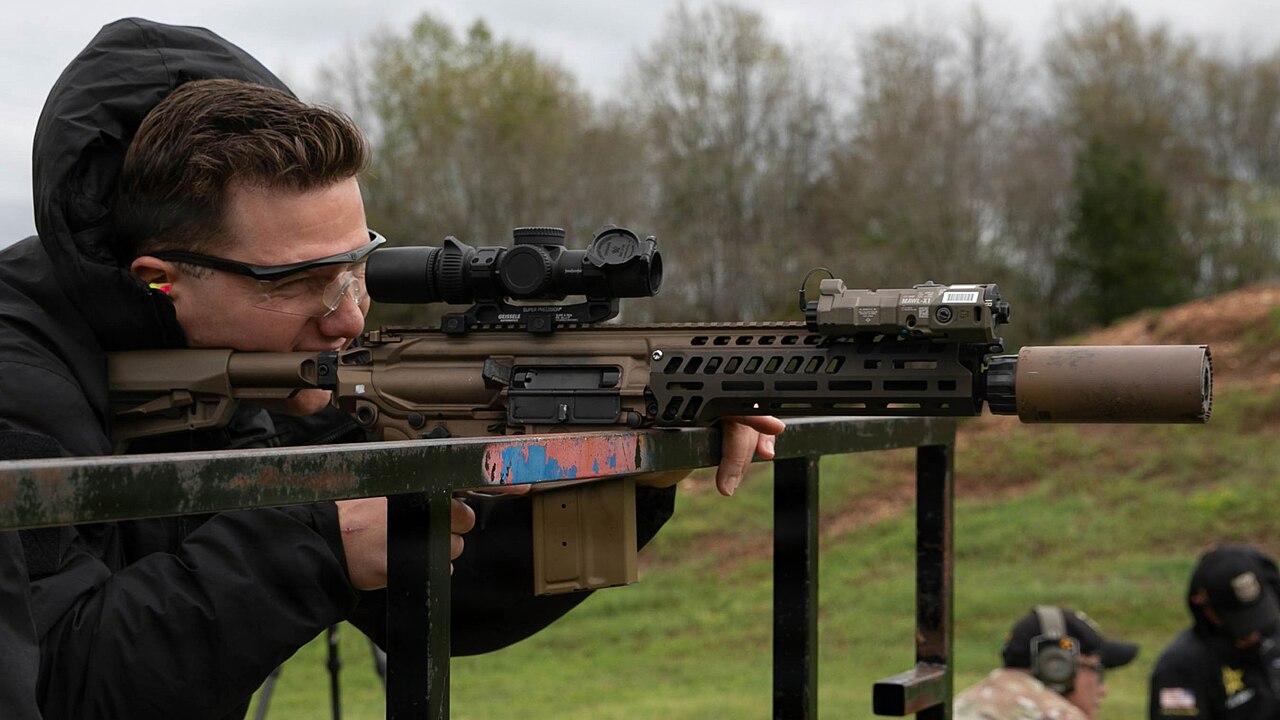
News had just emerged that the U.S. Army will officially introduce at the end of the year the carbine version M8 of its new rifle M7 in the 6.8 x 51 mm Common Cartridge caliber. SIG Sauer has now also announced a 25-round magazine for the family, as Army Times once again first reported. Following the development of the upcoming M8 prompted by complaints about the mass and dimensions of the M7 from the troops, the company is therefore also responding to criticism of the individual soldier’s ammunition stock with the previous 20-round magazine.
Weapons and ammunition were developed under the Next Generation Squad Weapons (NGSW) program by SIG Sauer based on the Army-specified 6.8 mm General Purpose Round (GPR). The rounds feature a hybrid metal case with a brass body and a stainless-steel base joined by an aluminum disk. This construction reduces cartridge weight by about 20 percent compared with a conventional design. Stainless steel also allows a higher yield strength and thus enables higher chamber pressures.
SIG Sauer responds to complaints about too little ammunition
Compared with the previous 5.56 x 45 mm NATO cartridge, this represents a significantly higher ballistic performance, which in combination with the standard M157 fire-control sight allows higher effective combat ranges and better effect against body armor and cover. The larger dimensions of the cartridge, which are roughly similar to the 7.62 x 51 mm NATO, also mean a greater space requirement in the magazine. In contrast to the M16/M4 family, which the M7/M8 are meant to replace in U.S. Army Close Combat Force units, this currently contains only 20 rounds instead of 30 rounds while having a similar loaded mass of 0.63 kilograms.
With the standard combat load of seven magazines, the individual soldier’s ammunition stock drops from 210 rounds to 140 rounds. Theoretically, this should be offset at least by the higher precision and effectiveness of the new system, but for the soldier it would initially mean fewer rounds at the man. With the planned larger magazines, his stock would rise to 175. However, of course at the price of more weight — a major point of criticism had already been that the increased total mass of the rifle together with the fire-control sight and the standard signature-reduction device as well as ammunition would take up too much of the infantryman’s target universal basic load of 55 pounds, i.e., 25 kilograms.
