
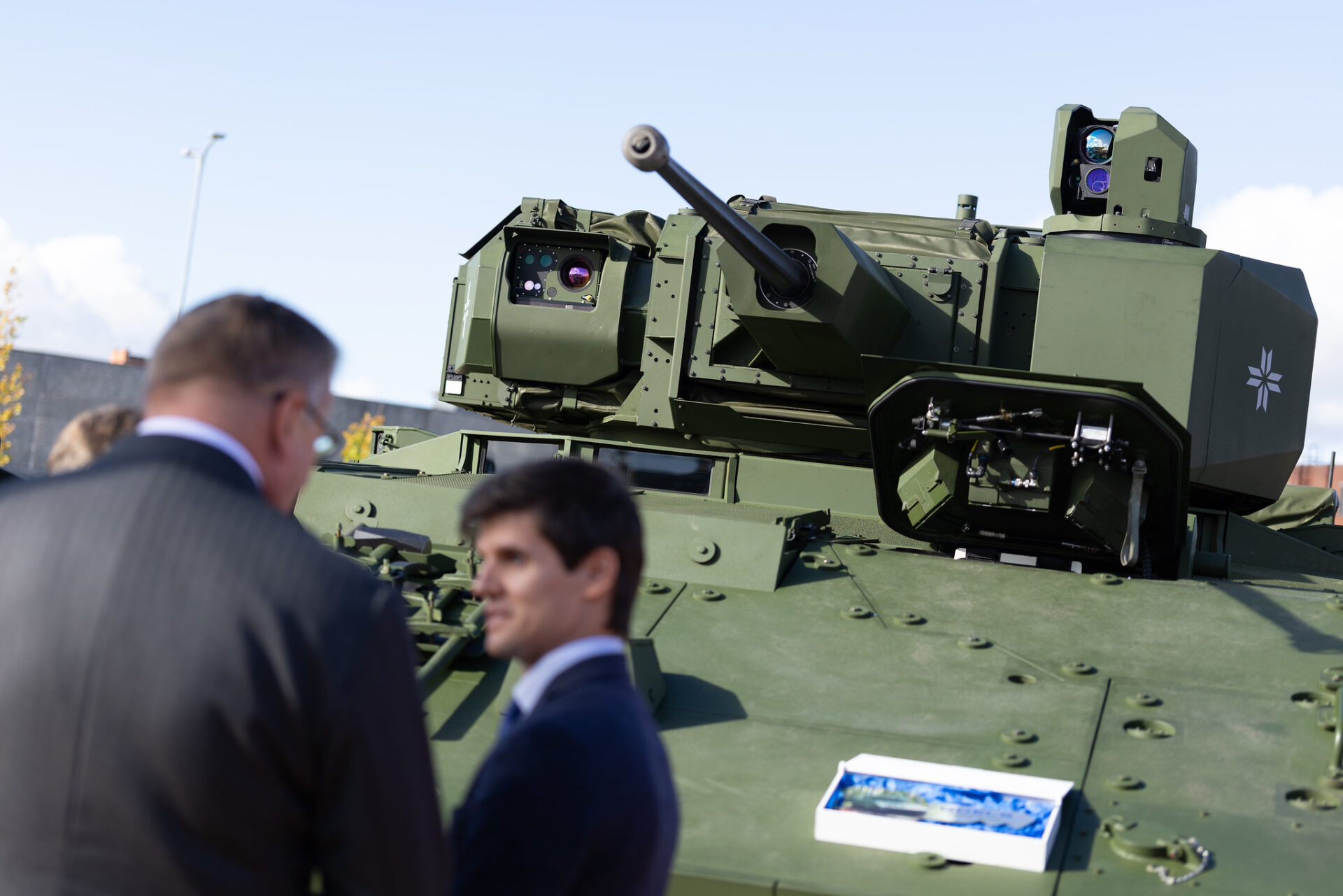
Latvia has taken delivery of the first ASCOD Hunter infantry fighting vehicle. A total of 84 vehicles are slated to strengthen the mechanized forces of the Baltic NATO member by 2029. Their armament largely originates from Israel: the unmanned UT30 Mk2 turret from Elbit Systems combines a 30 mm autocannon with Spike LR2 anti-tank guided missiles and modern fire-control technology. The protection can optionally be enhanced with the active protection system Iron Fist.
The New Infantry Fighting Vehicle of Latvia
With the ASCOD Hunter, Latvia is introducing a new generation of tracked infantry fighting vehicles. On 7 October 2026, industry representatives handed over the first vehicle specifically configured for the Latvian armed forces (as we reported). By 2029, a total of 84 Hunters are to follow, with which Latvia aims to improve particularly the mobility, firepower, and survivability of its mechanized infantry.
The basis is the ASCOD platform from the Spanish manufacturer General Dynamics European Land Systems – Santa Bárbara Sistemas (GDELS-SBS). For Latvia, a dedicated configuration was developed that is intended to meet the requirements of the national armed forces and cooperation with NATO allies.
A key element is the unmanned UT30 Mk2 turret from Elbit Systems. The Israeli manufacturer received in April 2025 from GDELS a contract valued at around 100 million US dollars for delivering turret systems suitable for ASCOD vehicles. According to Elbit, the contractual processing is to be completed by the end of 2027.
30 mm Bushmaster and Spike LR2
The main armament of the UT30 Mk2 in the Latvian configuration consists of a 30 mm Mk44 Bushmaster II autocannon from Northrop Grumman. The autocannon features a dual ammunition feed, allowing switching between two ready ammunition types without first having to change or reload ammunition. The stabilized weapons system also enables engagement of targets while the vehicle is moving.
As the secondary armament, there is a coaxial 7.62 mm machine gun. For engaging more heavily armored targets, the turret also includes an integrated launcher for Rafael’s Spike LR2 anti-tank guided missiles.
Thus the Hunter can engage not only infantry and lightly armored vehicles but also more heavily protected opposing combat vehicles. The combination of a autocannon, a machine gun, and anti-tank guided missiles enables the crew to select an effective weapon depending on the target.
Hunter-Killer Capability of the Infantry Fighting Vehicle
In addition to its armament, the sensors are among the essential capabilities of the UT30 Mk2. The turret has independently usable observation and targeting devices for the commander and the gunner. This allows both crew members to perform different tasks simultaneously. While the gunner tracks and engages a detected target, the commander can search for additional threats using his own optics.
As soon as a new target is identified, it can be handed over to the gunner. This so-called Hunter-Killer capability shortens the time between target recognition and engagement and is particularly important in rapidly changing combat situations. The fire-control technology also supports automatic target tracking. In combination with the two-axis stabilization of the weapons system, this is intended to enable precise target engagement even while in motion.
Optionally, Elbit offers the Iron Vision sight system for its turret architecture. This is a helmet-based system intended to give the crew an enhanced perception of the vehicle’s surroundings. Whether the Latvian Hunters will actually be equipped with Iron Vision, however, is not stated in the available information.
Protection for Latvia’s Hunter Infantry Fighting Vehicles
The UT30 Mk2 can be configured either with a manned or unmanned turret by default. For the Latvian Hunter, the unmanned, remotely operated version is planned. This means that no crew member needs to be in the turret during combat. The operation of the weapon system is conducted from the protected interior of the vehicle.
According to Elbit, the turret family also supports reload under armor and manual back-up modes for certain functions depending on configuration. Which of these options are implemented in the Latvian version is currently not reliably determinable.
In addition to passive armor, the protection of the UT30 Mk2 for Latvia’s infantry fighting vehicles is to be complemented by Elbit’s Iron Fist active protection system. Iron Fist belongs to the category of hard-kill systems. Such protection systems are designed to detect incoming threats and counter them with active measures before they reach the protected vehicle. Thus an active protection system adds another layer of protection on top of passive armor. Especially in light of the spread of modern anti-tank weapons and lessons learned from the war in Ukraine, this combination is gaining increasing importance.
Latvia: 760 Million euros for 84 Hunters
The Hunter itself is a Latvia-specific variant of the ASCOD tracked vehicle family. According to the Latvian Ministry of Defense, the vehicle has a crew of three soldiers and can additionally transport six infantrymen in full combat gear. The armor, according to the ministry, corresponds to NATO protection level 4.
The procurement of the infantry fighting vehicles occurred in two steps. In January 2025, Latvia initially signed a contract for 42 ASCOD infantry fighting vehicles worth 373 million euros. In June of the same year, a further 42 vehicles were ordered for 387 million euros.
Thus the total procurement volume stands at 760 million euros. The second order is intended in particular to accelerate the retrofit of another battalion of the mechanized infantry brigade. The program spans the period from 2025 to 2029. With the handover of the first Hunter in October 2026, the introduction has already begun.
Final Assembly in Latvia
An important part of the procurement project is the involvement of the Latvian defense industry. According to the Ministry of Defense, its share of contract execution should be at least 30 percent. The final assembly of the vehicles takes place in Valmiera at Patria Latvia. As early as June 2026, the Latvian Hunter variant was presented there. This links the acquisition of new infantry fighting vehicles with the development of the country’s own industrial capabilities.
Elbit’s turret systems are also provided, according to the company, with involvement of local industry partners. This should not only support manufacturing but also ensure supply and technical support for the systems. A corresponding subcontract for long-term maintenance was already signed in September 2025. This runs until the end of 2037.
With the Hunter, Latvia thus receives new infantry fighting vehicles in a timely manner, which also incorporate Israeli combat experience in their armament. In particular, the combination of stabilized 30 mm armament, anti-tank guided missiles, independently operating sight optics, and an unmanned turret is likely to significantly increase the firepower of Latvia’s infantry. Elbit’s turret has already been selected by the armed forces of Brazil, Israel, Romania, the United States, and several European states for different platforms, a testament to trust in the effectiveness of Israeli technology.
Author: Arie Egozi, Correspondent, Israel
