
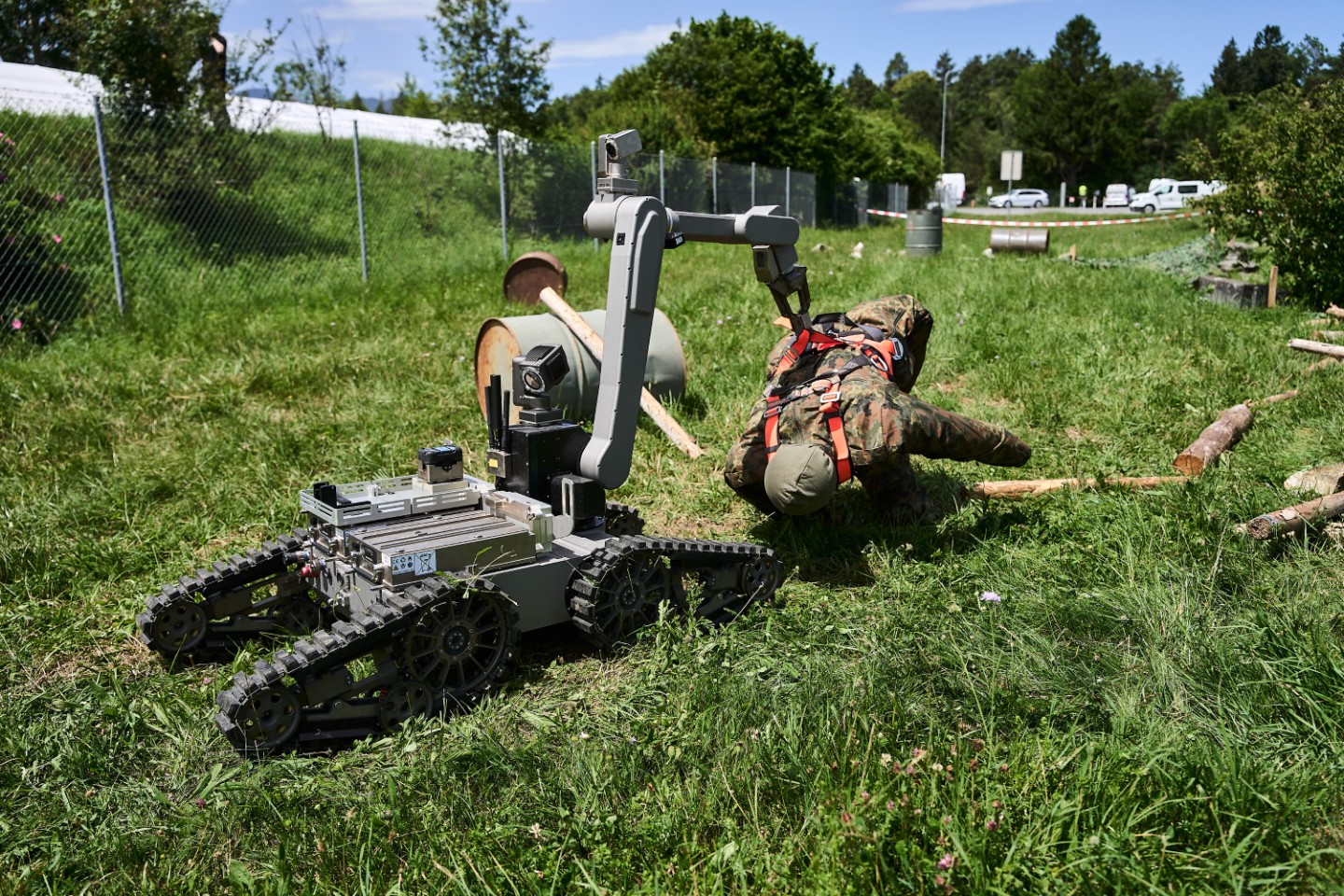
21 international teams – as many as ever before – faced in mid-June at the Thun firing range in Switzerland the tasks of the European Land Robot Trials (ELROB). Under realistic conditions they tested their unmanned ground systems in scenarios such as reconnaissance, convoy and accompanying transport (»Mule«). The five-day event made two things clear: the technology has made noticeable progress, while there are still significant capability gaps. This year the focus was mainly on navigation and autonomy.
Altogether five different scenarios had the team from the Fraunhofer Institute for Communication, Information Processing and Ergonomics FKIE, which has organized ELROB every two years since 2006, prepared for on the oldest and at the same time largest weapons range in Switzerland. In addition to the two disciplines reconnaissance and accompanying transport, in which starting positions were highly coveted, the schedule included convoy, locating and rescuing injured, as well as reconnaissance and neutralization of ordnance.

Orientation to the practical needs of the armed forces
In their preparations the scientists received valuable support from the Office for Army Development (AHEntwg) as well as the Federal Office for Equipment, Information Technology and Use of the Bundeswehr (BAAINBw), ensuring the close alignment with the practical needs of the armed forces. Since 2006, the NATO Research Task Group (RTG) 206 has also brought the international perspective into the performance comparison: Its members regularly convene on site during the event. Their results and standardization proposals are incorporated into the ELROB rulebook.
»It is this unique concept that keeps the event successful even 20 years after the premiere,« says ELROB initiator Dr. Frank E. Schneider, Deputy Head of FKIE’s Department »Cognitive Mobile Systems«. »Here research and industry, SMEs and startups, requirements holders and requirements discoverers come together and exchange ideas. This ensures that the event continuously stays at the pulse of the times and incorporates current developments.»
Participants travel from all over the world
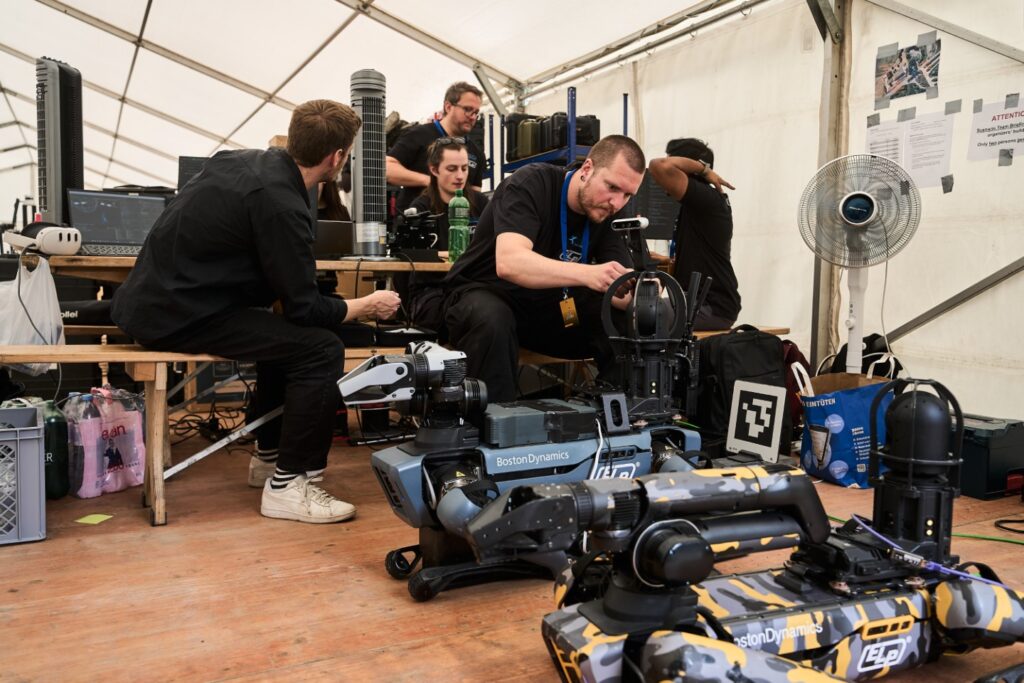
But the concept is not the only unique aspect. The international participants field, which this year again traveled to ELROB from across Europe, the USA and Canada, also makes the performance comparison an exceptional event. In the tent city the teams work around the clock on their robotic systems, getting them ready for the next run, troubleshooting, or engaging in technical discussions with colleagues. “ELROB always also reminds a bit of a big family gathering,” says Schneider. “The competition is part of it – the open exchange among each other and collaboration make the event what it is.”
The teams’ performances were evaluated this year as well by an internationally composed jury chaired by robotics expert Prof. Dr. Henrik I. Christensen. The jury noted substantial progress in automation and autonomy, where there are solid approaches in navigation and detection. In the use of Artificial Intelligence, however, the systems are “not yet in a frontline-ready state,” according to Schneider in his conclusion. “Overall, we could not identify any system that fully meets all requirements.”
Austria to host ELROB 2028
Particularly in wooded terrain the limits of automated driving functions continued to show themselves. Especially in narrow throughways or dynamically arising obstacles, many systems had clear difficulties. Schneider emphasizes: “Market availability is not equivalent to the ability of the systems to fully fulfill all requirements in the scenarios. While the vehicles are mature, no complete system consisting of vehicle, software and user interface could convincingly handle the challenges.”
Whether and what progress there will be in robotic systems can be demonstrated again in 2028: Then the FKIE team will organize the performance comparison on the impressive grounds of the Tritolwerk site in Eggendorf. On the Austrian side the host is the Office for Armaments and Military Technology (ARWT) under the leadership of Brigadier Jürgen Schlechter. Schneider: “In 2016 and 2022 we already carried out ELROB there with great success. Now we look forward to preparing the next edition under the expert leadership of ARWT.”
