
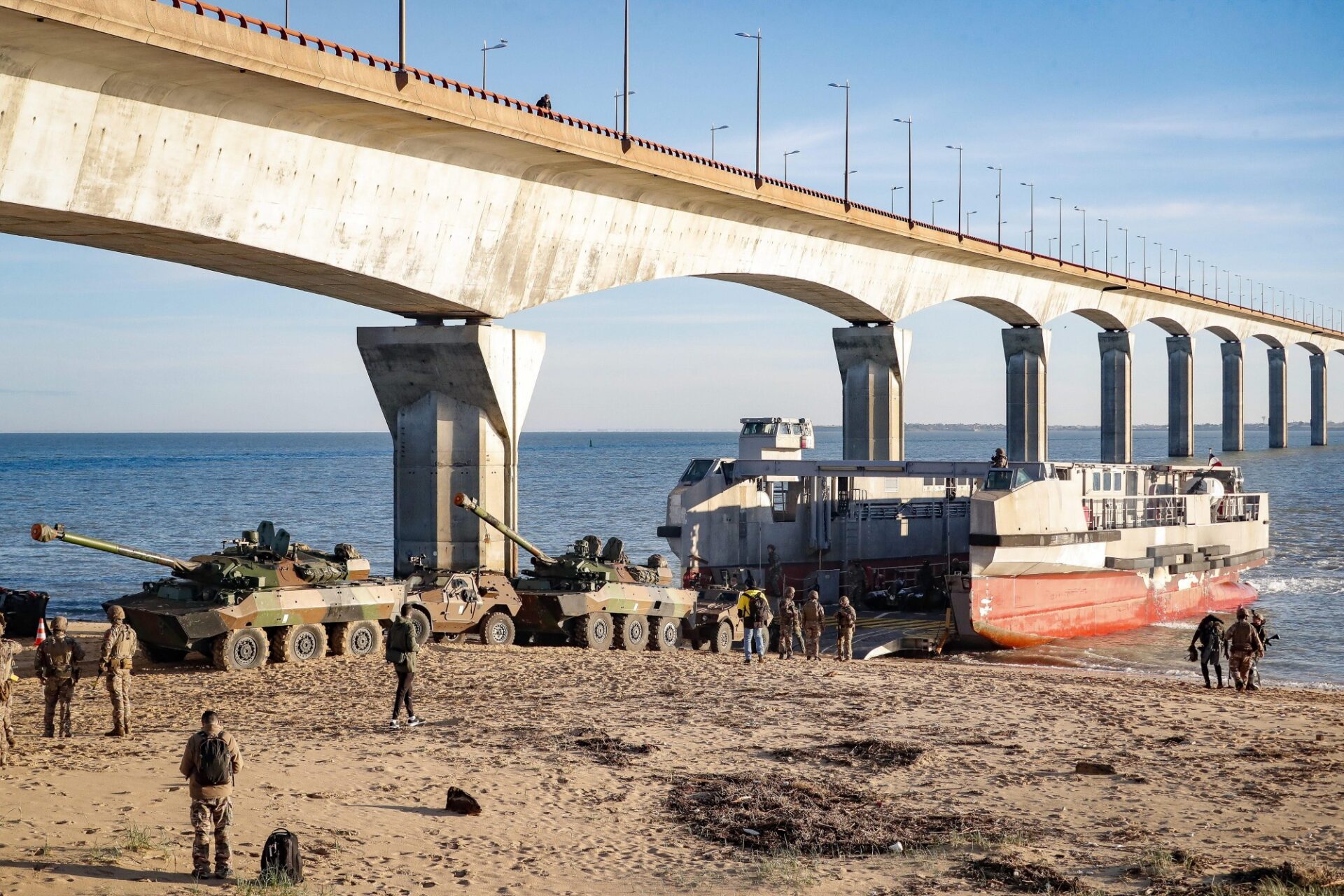
Orion 26 is still taking place in France until April 30. The scenario describes a Ukraine-war-adjacent conflict, in which the aggressor “Mercury” attacks the geographically France-identical “Arnland” initially with hybrid means, with the support of separatists and eventually with a conventional invasion. In total, more than 12,000 soldiers from 24 nations are involved across all dimensions. After a preparatory phase beginning in October 2025, the maneuvers—partly conducted as roaming full-scale exercises—began in February.
This included a sea and airborne assault operation involving the French aircraft carrier battle group Charles de Gaulle, the helicopter landing ships Mistral and Tonnerre, as well as the Italian San Giusto, the French 11e Brigade Parachutiste, the British 16 Air Assault Brigade, and parts of the Italian Folgore Paratrooper Brigade. From Germany, Tornado attack aircraft of Tactical Air Wing 33 from Büchel participated.
Orion 26 with multinational participation
Besides the full-troupe components, there is currently a staff framework exercise under the leadership of the headquarters of the French 1st Army Corps, which for the first time fully tests its new mobile command structure, based among other things on insights from Ukraine. The corps itself, previously Rapid Reaction Corps-France, only regained its traditional designation in January. In Orion 26 it commands a French, British, Italian, Polish, and Spanish division staff, respectively.
During this, a forward mobile battle post is deployed about 80 to 100 kilometers from the main combat zone, consisting of only 50 soldiers with a core of six armored command vehicles. A second command post further back is primarily responsible for logistics and host-nation support, while 90 percent of the leadership personnel focused on data processing are stationed fixed at the corps headquarters in Lille’s citadel.
Sovereign communication, but capability gaps in firepower
The three centers are connected by a hybrid network of ground, satellite, and mobile communications. One challenge, according to exercise participants, was especially integrating the equipment required for the mobile command posts into the small number of command vehicles of the VAB type, which in the future are to be replaced by the Griffon type. The initial integration of the French system into alliance structures also proved technically complex as the exercise progressed, which deliberately depicted parallel national and NATO command procedures.
Going forward, the system is to be complemented by a national capability for distributed work with AI-assisted data processing similar to the American Maven project. Already now the 1st Army Corps, according to its commanding general Benoît Desmeulles, can be deployed with sovereign communication without U.S. assistance. The biggest capability gap compared to an American corps remains in firepower, for example through tube and rocket artillery.

Lessons from the Ukraine War
The reason for the restructuring implemented within 18 months was not least the lesson from the Ukraine War that distance from the main combat area provides less protection for combat posts than mobility, dispersion, and “digital hygiene.” Setting up the forward combat post takes about 20 minutes, according to the 1st Army Corps, with improved camouflage and security along with systems for electronic warfare and drone defense taking two hours.
Nevertheless, the opposing exercise force initially located its position quickly due to its electromagnetic emissions and visual confirmation by drones. The corps’ 41st Telecommunication Regiment subsequently set up a decoy combat post with corresponding signature to mislead. According to General Desmeulles, such measures still need further improvement.
