
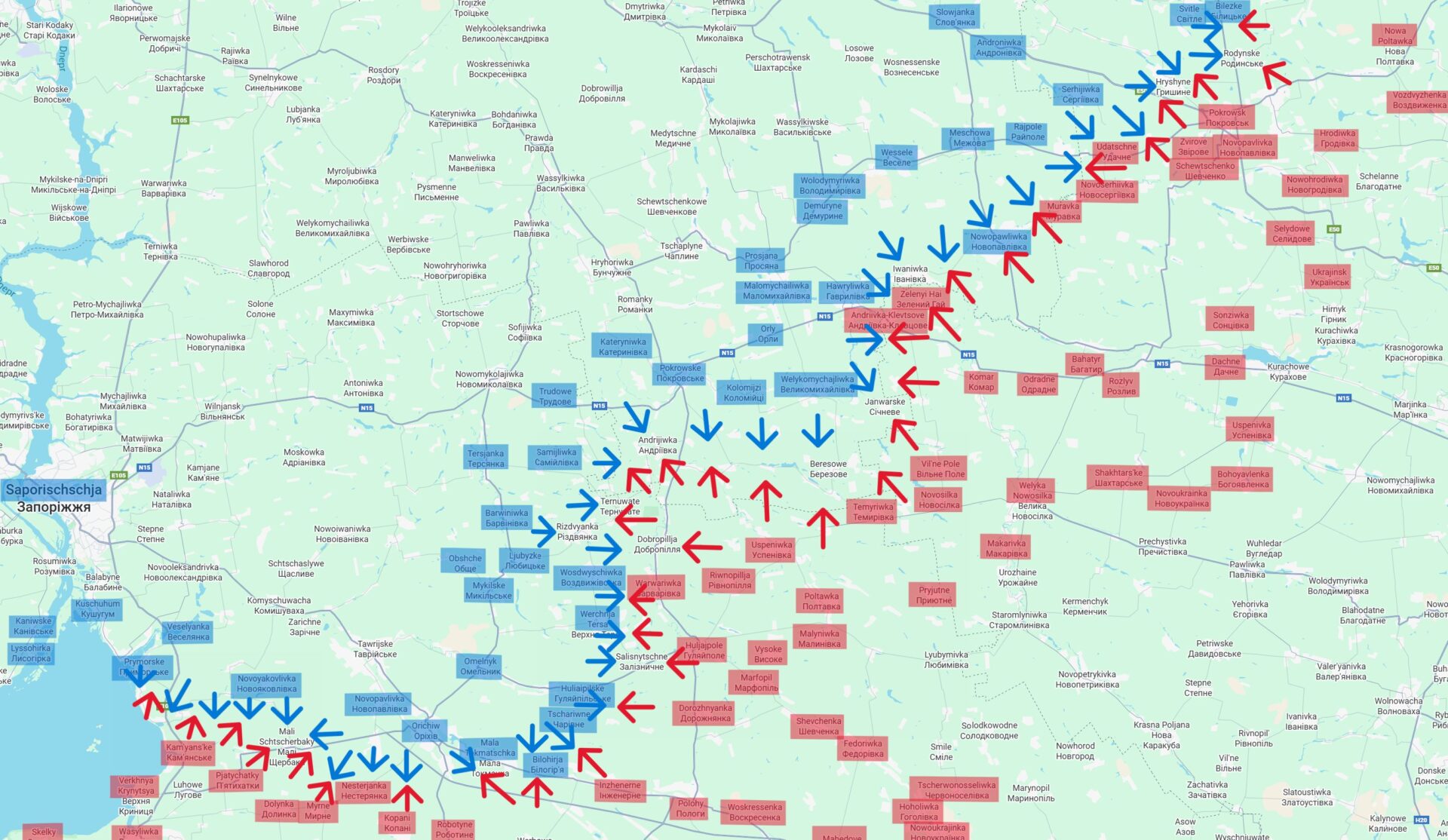
After the Ukrainian side achieved significant territorial gains in the Dnipropetrovsk Oblast during a counteroffensive last month, due to Russian communication problems following the blocking of smuggled Starlink satellite terminals and the Telegram messenger app, the front line in the Ukraine war seems to have stabilized again. More precisely, the previously described ambiguity about this, stemming from conflicting reports from both sides and the battles largely fought with drones and with a small manpower footprint, has returned.
Ukrainian sources thus portray the recovered territory as still under their own control. Russian sources, by contrast, claimed as recently as two weeks ago that it had largely been retaken and only small Ukrainian infantry squads were operating there. Since then they have not engaged with this front segment, although they also concede that Russian troops continue to be pushed slowly westward at the edge of the former Kakhovka Reservoir.
Slowing of the Russian advance in the Ukraine war
There are stronger reports of minimal front movements north of Pokrovsk, the fortress city taken by Russian troops last year, and at the edge of the further east Konstjanyniwka, in the continuation also at the Ukraine-retaken city Kupiansk and along the Ukrainian northeast border with Russia. However, little has been seen of the expected Russian spring offensive so far. Overall, according to observers’ calculations, the attackers lost a net about 30 square kilometers in March after gaining 120 in February and hundreds in the previous twelve months.
Although these figures may only be rough estimates given the uncertainties mentioned, they nevertheless seem to reflect a long-term stagnation of the otherwise arduous Russian advance. This impression is reinforced by various other – including domestic – assessments that point to growing problems for Russia in the war economy, in recruitment, and in defending against Ukrainian drone attacks. Despite a rise in oil prices due to the Iran conflict, Moscow’s revenue situation has not improved.
Ukraine relies on unmanned systems on the ground as well
Not least, Ukraine continues to intensify its campaign against production and loading facilities of the Russian oil industry, including the Baltic Sea ports Primorsk and Ust-Luga. Recently, repeated drone strikes triggered a persistent large fire at the Tuapse refinery on the Black Sea. In March, the number of Ukrainian long-range strikes exceeded the Russian ones for the first time. At the same time, Ukraine is increasingly relying on unmanned systems for ground combat and logistics. Last week President Volodymyr Zelenskyy stated that for the first time a Russian position had been captured solely with air and ground drones.
Thus, a scenario foreseen by Ukraine two years ago seems to be unfolding, in which Russia will hit personnel and material limits at the beginning of 2026. Whether this will translate into a slow return of the strategic initiative to Ukraine, further recapture of territory occupied by Russia, or a real ceasefire agreement remains uncertain. Moscow’s government is unlikely to be interested in a negotiated solution that does not at least include the complete conquest of Donbass, including the parts of Donetsk Oblast still held by Ukraine, as this would pose significant domestic political dangers.
